All the Levites who were musicians—Asaph, Heman, Jeduthun and their sons and relatives—stood on the east side of the altar, dressed in fine linen and playing cymbals, harps and lyres. They were accompanied by 120 priests sounding trumpets. The trumpeters and musicians joined in unison to give praise and thanks to the Lord. Accompanied by trumpets, cymbals and other instruments, the singers raised their voices in praise to the Lord and sang: “He is good; his love endures forever.” Then the temple of the Lord was filled with the cloud, and the priests could not perform their service because of the cloud, for the glory of the Lord filled the temple of God.
- Chronicles 5:12-14
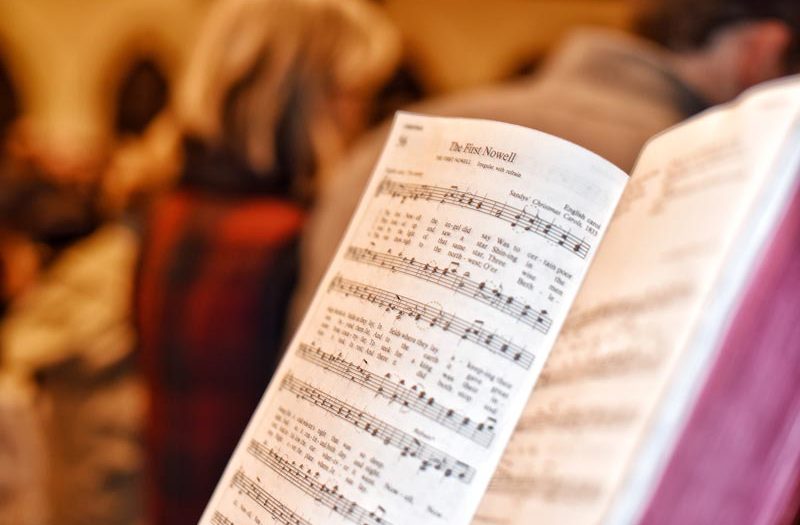
In the Bible belonging to Johann Sebastian Bach, next to this text from 2. Chronicles 5, we find a comment written by him: “Wherever there is devotional music, there God is always with his presence of grace.” Don’t we often deal with music in a divine service as if it were just a beautiful addition, a “festive framework” and not a very important part of the divine service? Yet music often gives expression to the Word and also to prayer! It allows us to receive the Word once again in a completely different way and guides our contemplation of the Word, sets notes to the reading and responds with the words of faith. We have all experienced how music and certain songs played a leading role in special situations.
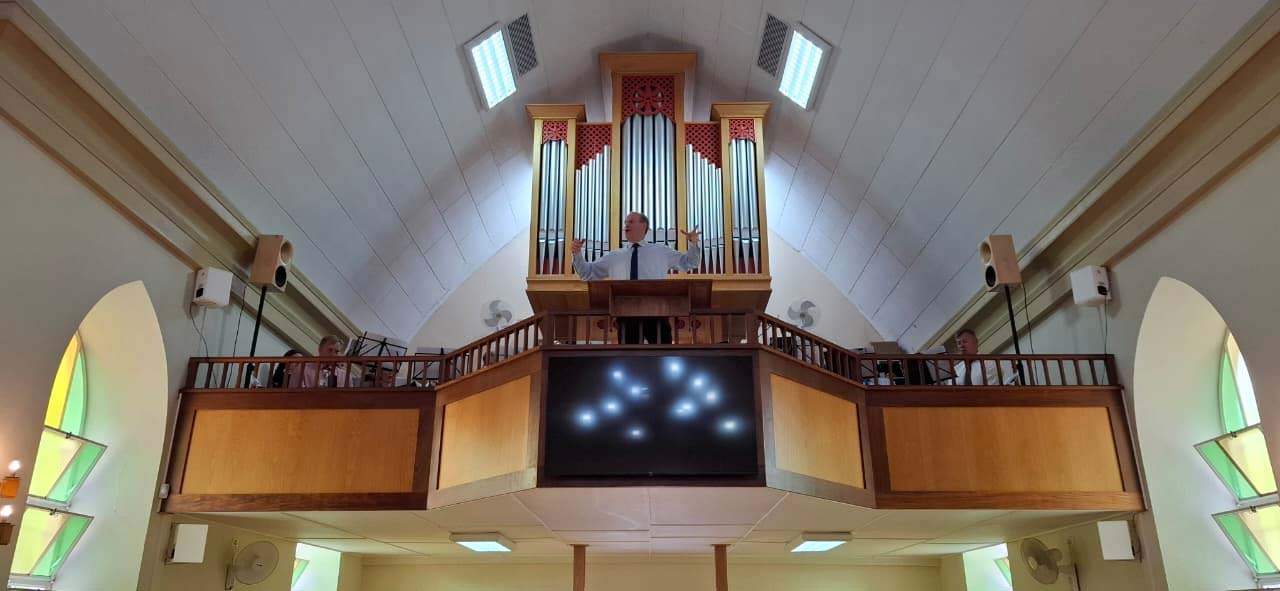
The Reformation gave the congregation its voice again, through the singing of hymns and other parts of the service. By singing the opening hymn, the thematically oriented hymn for the week, as an answer to the sermon and the closing hymn, the congregation is not only involved, but also assumes a task and function. She is an active participant in the divine service because it is also her divine service. The common singing and playing music in the divine service, e.g. during the Introit, the sung liturgy, the congregational singing, the participation of the choir and brass band, the celebration of the Lord’s Supper and the accompaniment of the organ, unites and allows us to experience fellowship. It connects not only those present with one another, but it also connects us with Christians worldwide and with brothers and sisters in the faith who formulated and expressed their faith decades, centuries, perhaps even thousands of years before us and preceded us into eternity.
The members of the brass band and the choir fulfil a very important task in the church through their ministry. This becomes clear during the singing and playing of music in the divine service. Here people contribute with their gifts. They not only meet regularly every week in rehearsals, but also appear as contributors to our divine services on Sundays, at church festivals, at old age homes, at birthdays and anniversaries, and not infrequently also at commemorations, funerals and urn burials. In places where mourning sometimes threatens to suffocate one’s throat, music and a sung word of consolation are used as substitutes for an extremely important service.
What kind of attention do we give to music in our congregation? The Bible does not portray God as someone who yawns during the songs while waiting for the sermon. God loves music and “dwells among the hymns of praise” of his children (Psalm 22:3).
This inspires us to reflect regarding music in our congregations. Music has the power to appeal to feelings and can inspire us (Psalm 40:3), mobilize us (Psalm 150:4) or give us rest (Psalm 62). It can pull us out of the mud of negative thoughts and feelings (Psalm 28:7). It can rejoice (James 5:13), exhort (Colossians 3:16), encourage (Psalm 21:13) and deliver (1 Samuel 16; even quite literally: Acts 16:25f). Singing and playing of music lets us
proclaim the power and deeds of God.
There is singing in the Bible:
- after miracles (Red Sea; Exodus 15)
- after victory (Judges 5, 1. Samuel 18:7)
- after harvests (Psalm 65:13)
- for instruction (Isaiah 5)
- because God does good (Psalm 13:6)
- because creation sings (birds; Psalm 104:12)
- as proclamation (Psalm 68:4,32; 96)
- in times when even lamentations fall silent (Psalm 137)
- in response to the judgment of God
(Isaiah 30:29). - as an adequate response to joy and well-being (James 5:13)
- as a sign of being filled with the Holy Spirit (Ephesians 5:19; Colossians 3:16)
- because I can’t help it and because I’m happy (Psalm 92, “praise psalm”)
The Bible sees the praise of God as the most beautiful task of the faithful (Psalm 33:1-3): “Shout for joy in the LORD, O you righteous! Praise befits the upright. Give thanks to the LORD with the lyre; make melody to him with the harp of ten strings! Sing to him a new song, play skilfully on the strings, with loud shouts.”
May the singing and playing of music in our congregation never diminish or only be regarded as a beautiful “addition.” A heartfelt thanks should be given to those who are involved in the various rehearsals and performances on a weekly basis and on
Sundays. Special thanks also goes to our choirmasters and organists, who tirelessly and with a lot of patience and commitment rehearse and accompany the Sunday hymns with us. May God reward you for it.
Source: Author unknown. Presumably taken from a draft by Bernhard Reich: The importance of music for faith, worship and church work. Lecture held 24.03.2011 at the District Synod KB Gaildorf in the School Centre Michelbach.
https://www.kirchenmusik.elk-wue.de/fileadmin/mediapool/einrichtungen/E_amtfuerkirchenmusik/Artikel/BezSynode_Gaildorf2011-03-24.pdf (accessed on 22.10.2019), 5ff.